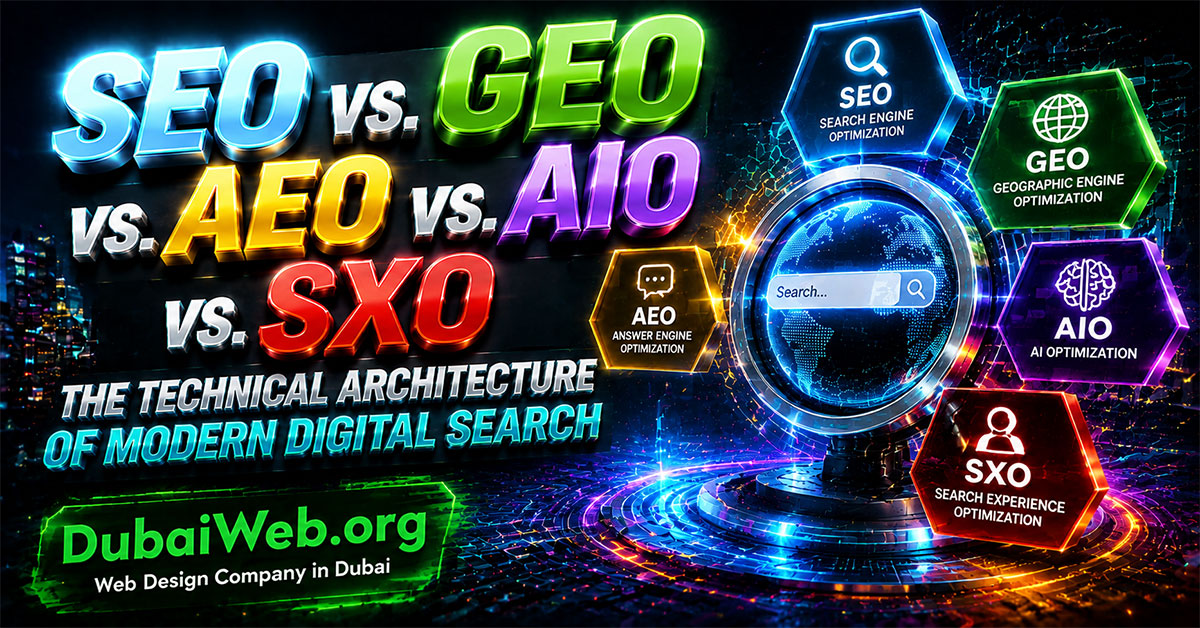
Direct Answer: Modern search requires five distinct technical disciplines: SEO builds structural SERP authority through keywords and links; GEO optimizes brand entity presence for Large Language Models (LLMs); AEO structures semantic data for direct zero-click answers; AIO captures Google AI Overview citations through multi-source topical alignment; and SXO turns post-click engagement into revenue through Core Web Vitals and frictionless UX. Unifying all five pillars ensures maximum market share in competitive business hubs like Dubai.
Search has undergone a fundamental architectural shift. The era of optimizing strictly for ten blue links on a traditional search engine results page (SERP) is over. Today, digital discovery spans conversational AI assistants, generative search panels, voice interfaces, and high-speed web application environments.
For brands and enterprises operating in hyper-competitive landscapes, visibility requires an integrated technical roadmap that aligns algorithmic indexing, vector embedding retrieval, entity graph verification, and post-click conversion mechanics.
Understanding the 5 Technical Pillars of Modern Digital Search
To establish dominance across standard web indexes and AI discovery engines, engineering teams and digital marketers must execute specialized strategies for each search pillar.
1. SEO (Search Engine Optimisation) – Structural SERP Authority
SEO remains the foundational layer of web discovery. It establishes a site’s crawlability, semantic hierarchy, and domain authority across traditional algorithmic crawlers like Googlebot and Bingbot.
- Technical Execution: Advanced XML sitemap clustering, canonical tag management, server-side dynamic rendering, semantic HTML5 structure, clean URL routing, and backlink authority building.
- Real-World Scenario: A luxury real estate platform in Dubai ranking #1 on Google SERP for competitive commercial keywords by utilizing optimized technical site structures and high-authority backlinks.
2. GEO (Generative Engine Optimisation) – Large Language Model Vector Mapping
GEO targets conversational AI ecosystems such as ChatGPT, Claude, Perplexity, and Google Gemini. When users request contextual queries or product recommendations, GEO ensures your brand entity is retrieved, synthesized, and cited within generated output responses.
- Technical Execution: Dense entity-relationship mapping, Schema.org JSON-LD structured metadata, third-party authoritative brand citations, clear factual disclosures, and machine-readable data feeds.
- Real-World Scenario: When an enterprise buyer asks ChatGPT, “Recommend top enterprise web development agencies in Dubai with custom API integration capabilities,” GEO ensures your brand is retrieved from vector indexes and presented as an industry leader.
3. AEO (Answer Engine Optimisation) – Zero-Click & Voice Discovery
AEO optimizes content specifically for direct knowledge graph engines, featured snippets, and voice assistants (Siri, Google Assistant, Alexa) that provide immediate, singular answers without requiring user clicks.
- Technical Execution: Implementing precise
FAQPageandQAPageschema markups, microdata formatting, concise 40-to-50-word answer blocks immediately following semantic header tags, and clean bulleted definitions. - Real-World Scenario: Dominating the position-zero snippet for voice and desktop queries like “What is headless CMS architecture?” with a perfectly formatted, schema-validated answer box.
4. AIO (AI Overview Optimisation) – Google AI Overview Synthesis
AIO focuses on securing placement inside Google’s AI Overviews and Copilot highlights. These systems synthesize live web data using real-time Retrieval-Augmented Generation (RAG) to display interactive summary cards above traditional SERP listings.
- Technical Execution: High topical coverage, multi-source consensus alignment, semantic content structuring using NLP-friendly vectors, and authoritative technical documentation that AI algorithms validate across external sources.
- Real-World Scenario: Appearing as a primary cited link card inside Google AI Overviews for complex queries such as “How to migrate a high-traffic Laravel application to cloud infrastructure in Dubai.”
5. SXO (Search Experience Optimisation) – Post-Click Conversion Engineering
SXO merges search optimization with User Experience (UX) and Conversion Rate Optimization (CRO). It guarantees that once a user or potential buyer lands on your site, the interface offers an ultra-fast, intuitive, and frictionless conversion pathway.
- Technical Execution: Optimizing Core Web Vitals (LCP under 1.2s, INP under 100ms, CLS under 0.05), mobile-first responsive interfaces, edge caching, lazy-loading assets, and frictionless conversion micro-interactions.
- Real-World Scenario: A financial services landing page achieving an instant 85%+ retention rate and 4x form completions due to sub-second load times and intuitive mobile booking workflows.
Comparison Matrix: SEO vs. GEO vs. AEO vs. AIO vs. SXO
| Pillar | Primary Objective | Core Technical Lever | Target Search Engine / AI Platform |
| SEO | High Organic SERP Rankings | Technical Crawlability, Keywords & Backlinks | Google, Bing |
| GEO | LLM Retrieval & Brand Citation | Vector Embeddings, Structured Entity Knowledge | ChatGPT, Claude, Gemini, Perplexity |
| AEO | Featured Snippets & Zero-Click Answers | JSON-LD FAQ Schema & Concise Direct Definitions | Google Knowledge Graph, Voice Assistants |
| AIO | Google AI Overview Feature Citation | Topical Depth & Multi-Source RAG Verification | Google AI Overviews, Microsoft Copilot |
| SXO | User Engagement & On-Site Conversions | Core Web Vitals, Edge CDN, UX/UI & Fast CTAs | End Users (On-Site Visitors) |
How to Integrate These Strategies for Enterprise Growth
Executing these five search pillars in silos leads to fragmented performance and missed market share. To establish true digital dominance, enterprises require a unified technical architecture where clean backend engineering, semantic data structuring, and user experience design operate in complete sync.
High-growth companies partner with specialized technical web agencies to build custom digital experiences. For instance, when engineering custom, high-performance web applications and corporate platforms, leveraging expert web design in Dubai ensures your digital architecture adheres to both strict search engine indexing requirements and high-conversion UX standards.
To dive deeper into technical optimization standards, server configurations, and site speed frameworks, explore the ultimate technical SEO checklist and toolset in 2026.
Furthermore, staying ahead of rapid algorithmic transitions is critical for maintaining market leadership. Learn how to prepare your enterprise infrastructure by reading our in-depth strategy guide: are you ready for AI search? A guide to SEO, AEO, and GEO in Dubai.
Why High-Performance Technical Web Architecture Drives Conversion
Traffic acquisition without conversion optimization results in wasted capital. That is precisely why leading enterprises trust Dubai Web to architect web systems engineered specifically for dual performance: AI/search engine discovery and maximum commercial conversion. A platform built by Dubai Web delivers:
- Sub-Second Loading Speeds: Edge-rendered content delivery and optimized script loading minimize bounce rates and maximize user retention.
- Advanced JSON-LD Schema Architecture: Rich metadata configurations ensure search bots and LLM scrapers accurately interpret your business services, products, and location entities.
- Mobile-First Core Web Vitals Optimization: Flawless interface responsiveness engineered specifically for mobile users across iOS and Android ecosystems.
- Conversion-Engineered Design Layouts: Clear visual hierarchies, trust badges, and strategic call-to-action (CTA) placements designed to convert high-intent traffic into qualified leads.
Conclusion
Dominating modern digital discovery requires expanding beyond conventional keyword optimization. By unifying traditional SEO with GEO, AEO, AIO, and SXO, your business builds total search authority—securing top rankings in search engines, authoritative citations within generative AI models, and maximum conversion rates from organic traffic. Partnering with technical engineering experts like Dubai Web ensures your web infrastructure continuously outperforms algorithm updates and drives sustainable, scalable business growth.
Frequently Asked Questions (FAQ)
1. What is the fundamental difference between SEO and GEO?
SEO optimizes web pages for traditional search engine algorithms to rank links on SERPs. GEO (Generative Engine Optimisation) formats structured data, entity relationships, and brand facts so generative AI models (such as ChatGPT and Gemini) reference and cite your business in conversational answer outputs.
2. Why is SXO crucial for e-commerce and B2B lead generation platforms?
SXO (Search Experience Optimisation) guarantees that incoming visitors experience sub-second page loads, intuitive navigation, and zero interface friction. High SXO directly converts organic traffic into paying customers or leads, dramatically improving marketing ROI.
3. How do Google AI Overviews (AIO) select sources for inclusion?
Google AI Overviews utilize Retrieval-Augmented Generation (RAG) to synthesize information from sites displaying high topical authority, schema-validated entity data, strong technical health, and multi-source web consensus.
4. Can an enterprise achieve AEO placement without technical Schema.org markup?
While structured formatting (such as H2 headers and concise lists) helps, technical Schema.org markups (JSON-LD) are critical for search engines to programmatically parse and pull content into zero-click featured snippets and voice search responses.
5. How does Dubai Web build web architecture optimized for all 5 search pillars?
Dubai Web develops custom, ultra-fast web platforms engineered with native schema integration, optimized Core Web Vitals, responsive UX/UI, and scalable technical architecture—ensuring complete dominance across SEO, GEO, AEO, AIO, and SXO.