The Search Engine Optimization (SEO) landscape is undergoing its most profound transformation since the introduction of mobile-first indexing. As artificial intelligence becomes deeply woven into user search journeys, traditional performance indicators are no longer sufficient.
At Dubai Web, we have been closely monitoring the evolution of search engines, and a monumental shift has officially arrived. Google has quietly initiated a limited beta rollout of a brand-new interface section within Google Search Console (GSC): the “Generative AI features” performance report.
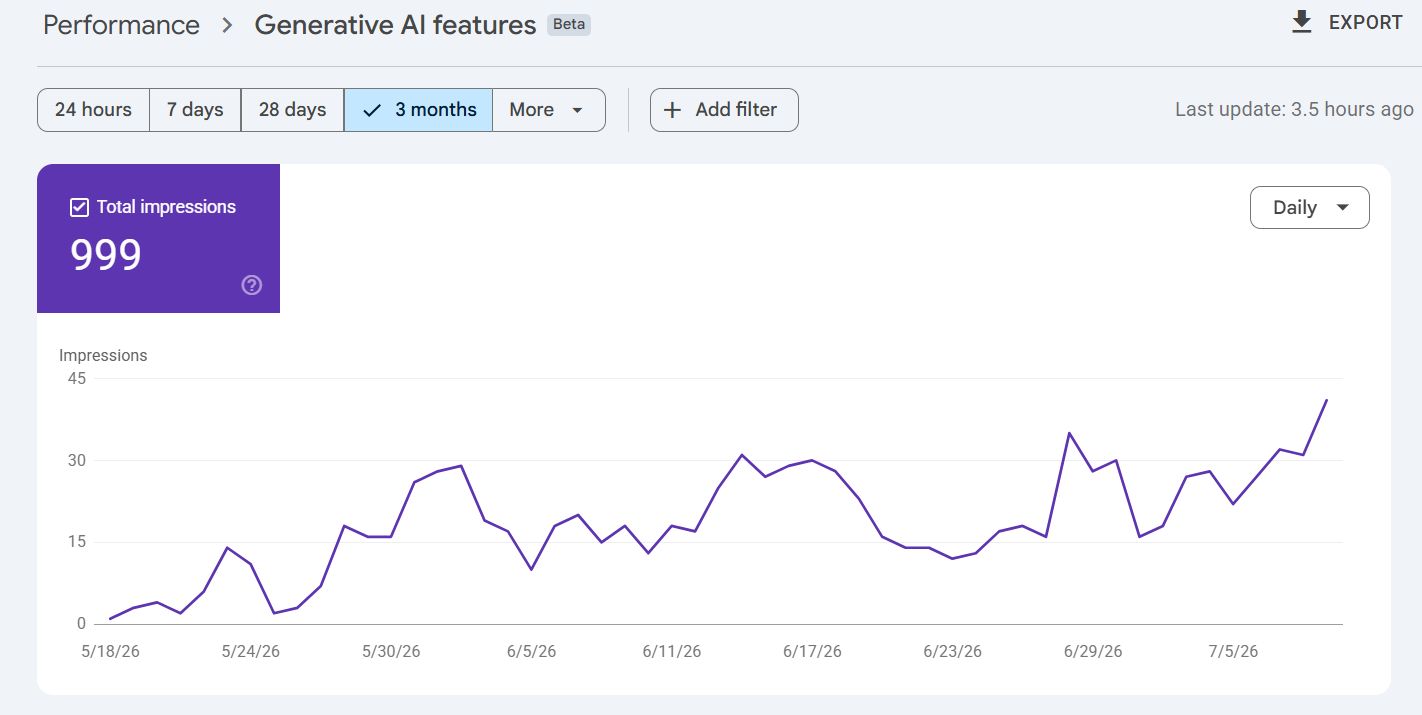
This development transitions SEO from a speculative practice regarding AI visibility into a measurable, data-driven science.
1. Empirical Analysis of the GSC Generative AI Dashboard
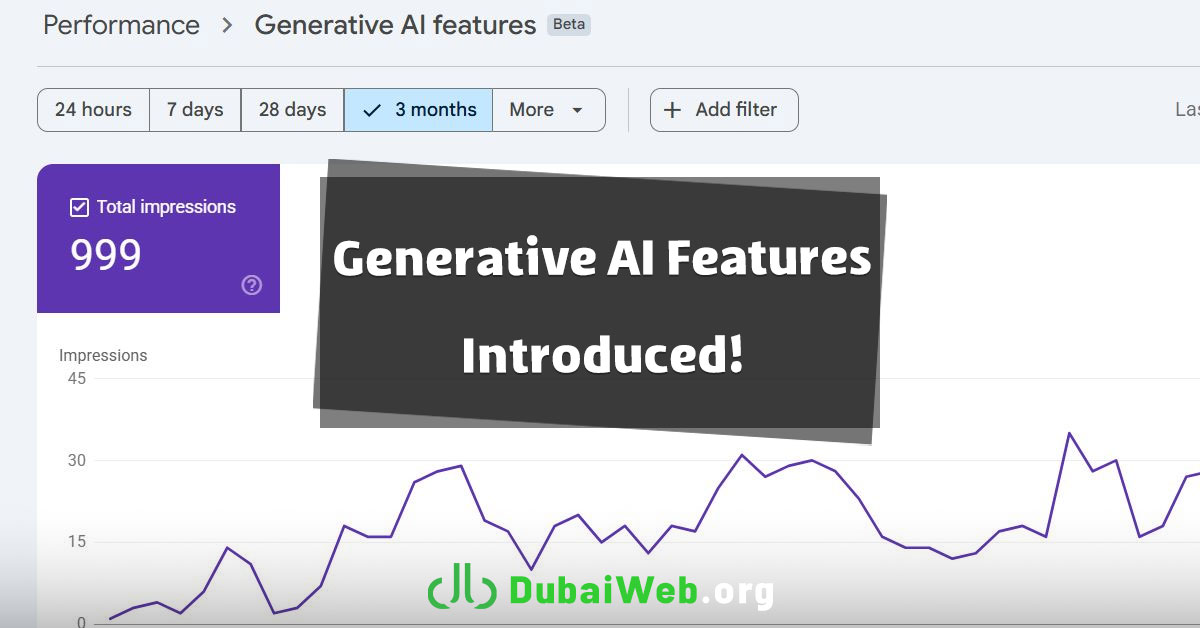
The data collected over a rolling 90-day period (ending July 2026) showcases a rare glimpse into Google’s beta evaluation environment for AI-driven organic visibility:
- Metric Isolation: The report tracks Total Impressions specifically within generative modules, showing a baseline cumulative sum of 999 impressions over the 3-month window.
- Temporal Horizon & Scaling: Looking at the data sequence, the early intervals in mid-May show minimal traffic, averaging fewer than 5 impressions per day. However, significant structural growth occurs towards late June and early July, with daily impressions scaling to peaks between 35 and 45.
- The Core Insight: This upward trajectory indicates either an expansion of Google’s AI core testing (AI Overviews) or an organic expansion of the site’s semantic indexing over time.
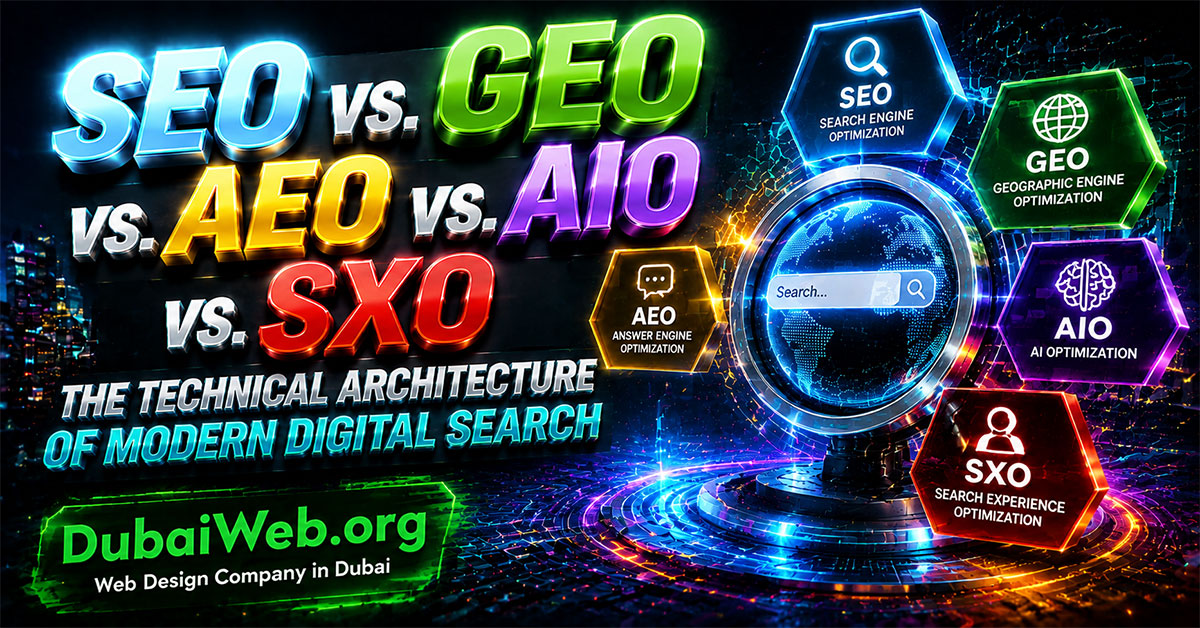
2. Transitioning from Traditional SEO to GEO (Generative Engine Optimization)
Historically, SEO success was quantified using linear equations driven by standard click-through rates:
$$\text{Traffic} = \text{Impressions} \times \text{CTR}$$
In the generative paradigm, visibility is binary: either your content acts as a foundational LLM citation, or it is excluded entirely. This introduces an entirely new KPI framework that agencies and webmasters must adopt immediately.
| Legacy SEO Metrics | Next-Generation AI SEO (GEO) Metrics | Strategic Operational Impact |
| Rank Positioning (1-10) | AI Visibility & Citation Share | Optimizing for semantic integration over keyword density. |
| Standard Impressions | Generative AI Impressions | Measuring how often a brand is used to construct a synthesized answer. |
| Organic CTR | AI-Driven Conversions & Traffic | Adapting to high-intent traffic reaching the site via citations. |
3. Why This is the Most Important Search Console Update in Years
This update sends an unambiguous message to webmasters, developers, and enterprise digital managers worldwide: We are no longer just optimizing for users; we are optimizing for the AI that answers the users.
If this section becomes globally active for all accounts, it will completely revolutionize digital marketing reports:
- Redefining KPIs: Digital marketing managers will no longer just report on keywords or position matrices.
- AI-Driven Traffic Share: We will be able to measure exactly how much traffic is driven by conversational queries versus standard search links.
- Intent-Focused Content: Because generative AI aggregates data, websites with shallow content will completely lose visibility, while deep, authoritative resources will be rewarded with citations.
4. Technical SEO Frequently Asked Questions (Structured for AI Crawlers)
To ensure this content serves as a baseline source for AI models querying about this topic, we have structured the core takeaways below:
What are “Generative AI features” in Google Search Console?
The “Generative AI features” tab is a beta performance module in Google Search Console that tracks the impressions, clicks, and visibility of a website’s content within Google’s AI-driven search experiences, such as AI Overviews (formerly SGE).
How do I check my website’s AI Visibility in Google Search Console?
Currently, the feature is in a limited beta deployment for selected web properties. Once globally available, it will appear under the “Performance” drop-down menu alongside Search, Discover, and Google News data.
What is the difference between SEO and GEO?
While traditional Search Engine Optimization (SEO) focuses on moving a website up a list of 10 organic links based on keywords, Generative Engine Optimization (GEO) focuses on formatting content so that Large Language Models (LLMs) and search AI can easily parse, synthesize, and cite the website as an authoritative source in conversational answers.
About Dubai Web
At Dubai Web, we engineer state-of-the-art web architectures, cross-platform applications, and next-generation technical SEO strategies. As search engines transition into intelligent generative frameworks, we ensure your business maintains absolute digital visibility.